Common Ground Gardening Blog: The Gentle, the Colorful, and the Furry: our Native Pollinators
“How do you get so many beautiful tomatoes?” Yacov, a Commonpoint neighbor, asked a few summers ago. He was gazing at the 6-foot-tall Sun Gold plants and their stunning clusters of Bing cherry-sized golden orbs. “My tomato plants,” he explained, “are just as tall and full of leaves, but no tomatoes in sight.” After I walked him through my process—from indoor seeding in March to outdoor planting in May—he assured me he had followed the same steps. However, the few flowers his plants produced soon dried out, leaving the branches barren. Why? Why? Why did it happen to him? “Do you have flowers in your garden?” I asked. Yacov looked at me quizzically: “No,” he said. “My wife doesn’t want bees in our garden. She doesn’t like them.” So, I spent the rest of our conversation trying to convince him that, without flowers, he can’t have bees and bumblebees. Without bumblebees, his tomato flowers won’t be pollinated, and without pollination, the plant won’t bear tomatoes. I presented him with a tough dilemma. But I saw in his eyes that, ultimately, his love for his wife of 40 years would outweigh his desire for garden-grown tomatoes.
As a wife, I salute the sacrifice. However, this highlights the core of our environmental challenge. As an urban gardeness dedicated to informing the community about the vital role of wildflowers and their co-evolution with numerous pollinators over millions of years, I felt compelled to write this post.
Neil de Grasse Tyson famously said, “The universe is under no obligation to make sense to you.” In other words, human perspective is irrelevant to the workings of the universe. In the same spirit, I like to paraphrase the great communicator of all things cosmic and bring his quote down to an earthly scale: “Nature is under no obligation to make sense to you, nor to cater to your desires or needs.” We have tried to bend nature to our will for centuries. The results, however, speak for themselves.
In the city, we may not think much of the disappearance of Monarchs and Solitary Bees until our backyard tomato plants grow 6 feet tall without yielding a single fruit. Yes, you might have peonies, roses, lilacs, and even some blooming prunus in your neighborhood. They attract bees, which is a good thing. However, by the time your tomatoes are ready for pollination, peonies and lilacs will have long withered, and most of the bees will be gone. Some stragglers may remain for the roses, but they won’t do much to help your tomatoes, which require a bumblebee’s powerful buzz pollination to produce their full yield.
So, what is a gardener to do to get their tomatoes to grow and produce?
In spring, when tomato plants are still germinating behind a sunny window in your house and native bee and bumblebee queens finish hibernating, ensure they find your garden and settle nearby. Provide them with what they need when they emerge from hibernation: sow WILDFLOWERS around and in your future tomato beds. By the time you bring out your pubescent tomato plants in mid-May, your garden will already host a few bumblebees. In June, when tomato blooms begin to appear, the bumblebees will spring into action and stay until September, or as long as your plants continue flowering. If you have done everything right for your tomatoes—fertilizing, composting, watering, pruning, and mulching—you should enjoy a bountiful harvest.
What if you’re afraid of bees or bumblebees? What can I say? Unless you have a serious allergy to bee venom, there’s no reason to fear bees and bumblebees. If you don’t bother them, they won’t bother you because their main goal in life is to find nectar and pollen to feed themselves, their brood, and their queen. Also, they are vegetarians. So you are not on their menu du jour. And what’s true of native bees is even more true of bumblebees, which will ignore you completely, even if you garden just a few inches from them. I speak from experience.
What if you don’t grow tomatoes? Can you ignore pollinators? Only if you believe you can live without oxygen.
Pollinators like bumblebees and native bees, as well as other less effective pollinators, feed birds. Fewer pollinators result in fewer birds. Birds consume many pests in our gardens, including worms, grubs, mosquitoes, slugs, and wasps. They also disperse seeds. Their digestion and waste help plants and trees grow over long distances. In addition, birds feed on certain pests—such as common leafhoppers—that threaten trees’ health.
Without birds, trees can become weak, and weak trees will eventually die. In the City, fewer trees affect water drainage, which is essential in our neighborhood, and also decrease oxygen levels. Trees provide shade and help cool the air during hot weather, which in turn reduces the need for air conditioning and lowers those shocking summer electric bills.
We can’t imagine Earth without trees—or with too few: they produce 50% of the oxygen we breathe.
In a nutshell, pollinators are why you can still enjoy a modicum of breathable air in this neighborhood.
First, there are the bees, with 200 species in NYC alone. They make up 68% of all pollination in our City’s green spaces, including your favorite park, yard, porch, or balcony.
I will only focus on the ones I most frequently see in Commonpoint gardens.
These come in two distinct groups: 1. The Wild Bees and 2. The Honey Bees.
1) The Wild Bees, also known as Native Bees or Solitary Bees, have been buzzing around our neck of the woods for as long as flowers have been blooming on this continent. In short, they are native to our neighborhood.
The Tiniest:
The Gotham Sweat Bees range in size from a sesame seed to a rice grain. The females display a stunning metallic green, while the males prefer electric blue.
The Biggest:
The Easter Carpenter Bees are about one inch long. They have a round, shiny, black abdomen and a yellowish, fuzzy thorax. Because of their size and the strength of their buzz, they are often mistaken for bumblebees.
However, the distinctive hairy bodies of our Bumble Bees set them apart from all other bees. Bubble bees are the cuddly-looking ones.
The Gentlest :
As I mentioned earlier, bees are not aggressive insects. They may sting, but only when they feel threatened. Except for the loveliest of all: the Mason Bees. In our neighborhood, Mason Bees are small, fuzzy, mostly gray with a bluish sheen. Although the females of the species have a stinger, they rarely use it. When they do, one hardly feels a tiny pinch, nothing remotely comparable to even a mosquito bite.
The Furriest:
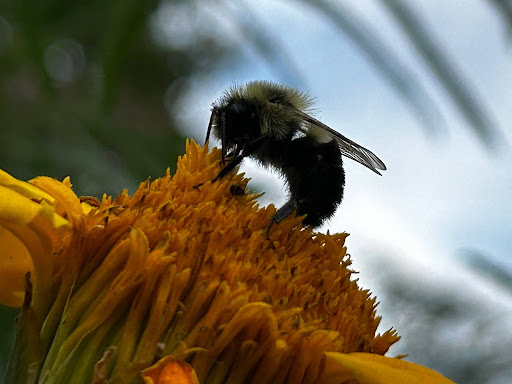
And my personal favorite: the Bumblebees. Despite many differences between a bumblebee and a bee, they belong to the same family. Our gardens are home to Two-Spotted Bumblebees. Their heads, abdomens, and legs are covered in dark gray hair, and their thorax has pale yellow hair with a large black spot in the middle of the back. They may not be the prettiest, but they are far better pollinators than honeybees. Starting in May, you can see our Two-Spotted Bumblebees buzzing around the Oakleaf Hydrangea in the Butterfly Garden. Then they spread out throughout the rest of the gardens. By June, they are pollinating our tomatoes, and in July, they work on our beans, cucumbers, and zucchini. In the fall, they are the last ones standing—or rather, pollinating. Honeybees do not tolerate a wide temperature range. They will call it a day when the thermometer drops below 80°F. Conversely, I have seen bumblebees barely alive, still trying to collect nectar from our last marigolds in late November.
2) The Honeybees
These are our gardens’ stars. Honeybees appear in children’s books, starting with primers. At the Nursery, two-year-olds know about them. Three-year-olds know they eat honey. Five-year-olds know that they make honey. Honeybees differ from the wild species mentioned earlier in many ways.
They are not indigenous to this continent; European colonists brought them over in the 17th century. They are medium-sized, mostly amber or light brown with dark brown stripes. Their thorax is hairy, and a light fuzz covers the rest of their body, including their legs and eyes.
They are not wild; they are domesticated (think “farm animals”), and they have been for at least 7000 years in Africa, where they originally come from.
As is typical of domesticated animals, they enjoy a mutually beneficial—albeit increasingly questionable—relationship with humans. We build them hives in return for their pollination skills and their honey and wax.
Honeybees live in highly organized colonies of up to 4000 members.
Their Queens can live up to 4 years before they are replaced or die.
Honeybees are not as chummy as wild bees. They have a Queen and a whole colony to defend. And defend they will, even if stinging the threat—a process that rips their abdomens apart—costs them their lives.
In North America, Honeybees are the only species that produce honey.
After the bees, let’s mention a few look-alikes :
The Hoverflies. They are one of our garden’s native unsung heroes. You might have seen these tiny creatures, about a quarter of an inch long, hover over a flower head and then zoom in and out with a loud buzz. With their yellow and black bodies, one could easily mistake them for a wasp. They are neither wasp nor bee; they are flies.
How can you tell? Their reddish eyes are so big that they make up half the size of their heads. They also have only one pair of wings, while all bees have two pairs.
Hoverflies cannot bite or sting.
Then, we have the infamous wasps…
The WASP? I can imagine your horror after reading about all those mild-mannered pollinators. Deversed or not, wasps have a bad rap sheet. I won’t pretend that I like them. BUT… please hear me out. Just as there are different types of bees, there are different types of wasps. Although they are all decent pollinators, three are considered pests in New York: the yellow jacket, the paper wasp, and the hornet. I don’t know enough about these species to identify them responsibly in those lines.
However, wasps, like bees, can be either social or solitary. Yellow Jackets, Paper Wasps, and Hornets—the scourge of our gardens, 4th of July barbecues, and any outdoor events involving food—are social insects that build large colonies. Because they need to protect their Queens and colonies, they are notoriously aggressive.
Solitary wasps, on the other hand, are gentle insects. And they look stunning! I have seen a few in Commonpoint’s gardens over the years. The most common is the Black Winged Scolia, or Noble Scolia. They live in individual holes in the ground, which they dig close to one another. They live alone but feed as a group. When I work in the Butterfly Garden by early July, they buzz around me, from one flower to another. I don’t mind them. They don’t mind me. We have a mutual understanding.
The Blue Wing Scolia is even more beautiful. It has a long, graceful body and striking blue wings with a metallic sheen. I have seen them around. They, too, keep to themselves and rightly expect the same from me. The few I observed had selected holes in an old wooden fence for their nests.
The Common Thread-Waisted Wasp is an odd beauty. The first time I saw one, I couldn’t even make sense of what I was looking at. They look like chimeras, made of two unrelated insects. They hold their abdomens high above their thoraxes, giving them an air of ominous defiance. But they are as gentle as their other solitary cousins. They won’t hurt.
And now for everyone’s favorite: the Butterflies…
As pollinators, butterflies are less effective than bees and bumblebees. However, they can pollinate flowers that bees and most bumblebees cannot access. We have three specimens of these plants in the garden: they are Trumpet or Coral Honeysuckle. These flowers are shaped like tiny, long, narrow trumpets that cannot accommodate a bee’s body. But butterflies have long “tongues” (also called proboscis) that are 80% of their body length. Rather than a tongue, the proboscis is a tube that butterflies use to reach the nectar and pollen at the bottom of the narrow flower. When they finish with a flower, they coil their proboscis under their heads until they find another flower to feed from. Many of these butterflies and their caterpillars serve as an essential source of protein for our Robin, Blue Jay, and Warbler populations. Sparrows, Cardinals, and Mockingbirds, though omnivorous, feed their young strictly on insects.
And last but not least: they bring authentic, unconditional joy to our lives.
New York City is home to 110 varieties of butterflies. At Commonpoint, I have observed at least 8 species (see the slide presentation). The largest and most spectacular are the Monarchs and the Swallowtails. Last summer, we saw them almost every day, starting their rounds by 10 or 11 am, just when we, humans, start melting in the sun. And yet, according to the Xerces Society, Monarch populations in North America have declined by over 80% since 1997, and Swallowtail populations by 20% in the past 20 years. So, you may ask, what is so special about Commonpoint’s gardens that makes it a summer haven for those rare flying beauties?
I’m glad you asked. The answer is: WILDFLOWERS, which takes us back to the beginning of this post: Native pollinators need Native flowers to thrive because they’ve coexisted for thousands of years. Similarly, native flowering plants depend on Native pollinators to survive. Their symbiotic relationship produces strong, resilient pollinators that can pollinate more effectively than honeybees.
Why should we worry so much about just a few native plants? —Because the list of native plants that require the expertise of Native pollinators also includes squashes, pumpkins, gourds, tomatoes, blueberries, cranberries, raspberries, strawberries, cherries, plums, eggplants, peppers, potatoes, melons, and several others.
Last year, from spring to late fall, Most Commonpoint members and neighbors saw the spectacular flower beds along the Pantry Garden’s white fence, the Butterfly Garden, and the new bed at the corner of 67th Road and 108th Street. These were all Wildflowers. In the fall, we collected seeds from many of those flowers. In May, we will give away our live plants. If you want to help our Native pollinators and our entire local ecosystem thrive, stay tuned for our next announcement.
REFERENCES
UC Davis, Department of Entomology and Nematology,
« The Evolutionary History of Bees in Time and Space »
https://entnem.ucdavis.edu/news/evolutionary-history-bees-time-and-space
U.S. Department of Agriculture “Why Garden with Native Flowers.”
https://www.fs.usda.gov/wildflowers/Native_Plant_Materials/Native_Gardening
National Wildlife Federation: “Start Planting with a Purpose”
https://www.nwf.org/Native-Plant-Habitats
Cornell CALS, Pollinator Network: “About New York’s Bee Diversity”
https://cals.cornell.edu/pollinator-network/ny-bee-diversity
Cornell CALS, Integrated Pest Management, “Hover Fly”.
New York City Parks: “ Pollinators in New York City Parks: Bees, Butterflies, and Beyond.»
New York State Park Blog: “The wonderful world of the Mason Bee.”
PBS: “Human relationship with honeybees dates back 9,000 years.”
https://www.pbs.org/newshour/science/humans-relationship-honeybees-goes-back-neolithic-era
US Fish and Wildlife Services: “Monarch”
https://www.fws.gov/species/monarch-danaus-plexippus
Audubon: “Guide to Northern American Birds”
https://www.audubon.org/field-guide/bird
New York City Department of Parks: « Pollinators in New York City Parks: Bees, Butterflies, and Beyond »
Xerces Society: « Western Monarch Population Closer to Extinction as the Wait Continues for Monarchs’ Protection Under the Endangered Species Act »
Xerces Society: « State of the Butterflies in the United States: A Roadmap for Recovery »
https://xerces.org/bug-banter/state-of-butterflies-in-united-states-roadmap-for-recovery
US Geological Survey: “What is the role of native bees in the United States?”
https://www.usgs.gov/faqs/what-role-native-bees-united-states